The Center for Educational Big Data and Evaluation (CEBE) has developed a unique interdisciplinary approach by integrating education, statistics, computer science, and psychology. It aims to build a big data sharing platform and an advanced skills assessment system that meet modern needs. The center also focuses on improving data governance and creating a support platform for educational measurement, evaluation, and decision-making — helping drive the digital transformation of education and keeping educational assessment up to date with the times.
PART 01 Faculty Team: A Convergence of Distinguished Talents with Exceptional Research Capabilities
Professor LIU Li serves as the director of the center, with Associate Professor LU Chang as the deputy director. The team brings together scholars with international perspectives and strong academic credentials, including recipients of prestigious national and Shanghai talent awards, forming a well-structured and dynamic research group. The core members include:
LIU Li Professor and Director
She primarily engages in research on scientific research evaluation and policies in higher education institutions, as well as education evaluation and policies. She is an Outstanding Talent in the New Century by the Ministry of Education and a Renowned Teacher for Employment Guidance at SJTU. She has presided over more than 10 national and provincial-level research projects, published 10 academic works, and contributed over 50 papers to core journals. Many of her research achievements have won national and provincial-level awards.
LU Chang Associate Professor and Deputy Director
She primarily engages in research on educational data mining and learning analytics, educational measurement and evaluation, and educational information technology. She is a High-Level Overseas talent introduced by Shanghai and a recipient of the Shanghai Pujiang Talent Program. She has presided over multiple research projects at the provincial, ministerial, municipal, and university levels.
WANG Shuai Associate Professor
He primarily engages in STEM education assessment, application and evaluation of educational technology, and educational psychology studies. He is a High-Level Overseas talent introduced by Shanghai and has led or deeply participated in over twenty research projects in both China and the United States.
MA Yue Associate Professor
She primarily engages in educational statistics, measurement and assessment, as well as educational psychology research. She is a Shanghai's High-Level Overseas talent and a recipient of the Shanghai Pujiang Talent Program. She has presided over multiple research projects at the provincial, ministerial, and municipal levels.
LI Tingxuan Assistant Researcher
She primarily engages in research on statistics and educational measurement. She has taught multiple courses in educational statistics and measurement, consistently receiving top evaluations in student assessments.
PART 02 Research, Education, and Service: Shared Commitment and Collective Endeavor
1. Research Innovation: Fruitful Outcomes with Growing Influence
CEBE faculty regularly publish high-quality research in leading academic journals, enhancing SJTU's global academic presence. Over the past three years, they have published more than 40 high-level papers and earned one provincial outstanding research award.
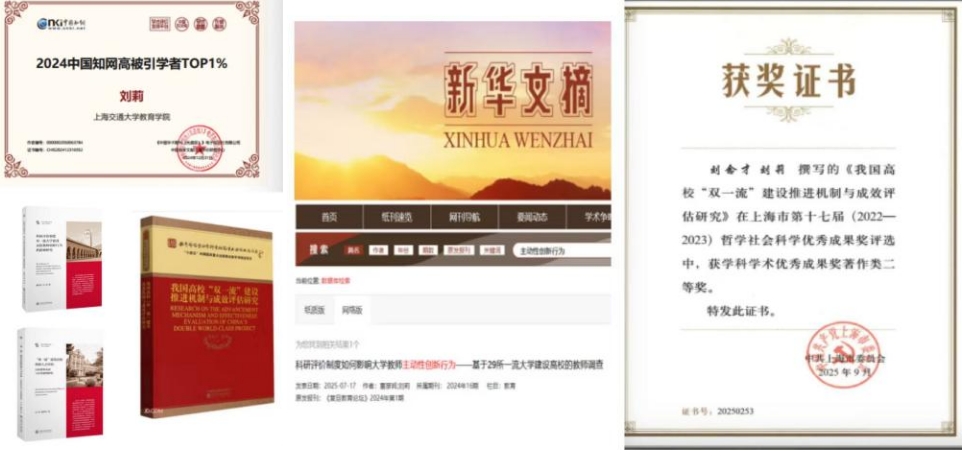
Prof. LIU has published multiple articles in top-tier journals including Educational Development Research, Fudan Education Forum, and China Science & Technology Forum. Her paper “How Research Evaluation Systems Influence Faculty Innovation Behavior” was fully reprinted by Xinhua Digest. In 2024, she was recognized as one of the top 1% most-cited scholars on CNKI.
Prof. LIU has also authored three academic books in the last three years, one of which received the Second Prize of the Shanghai Outstanding Achievement Award in Philosophy and Social Sciences.
Dr. WANG has published papers in leading educational journals such as Higher Education and Educational Technology Research & Development. His study on educational disadvantage was highlighted by Times Higher Education and shared with the global higher education community. Dr. LU has published more than 20 papers in top-tier international journals including Computers & Education and Computers in Human Behavior. Dr. MA has published in journals including Thinking Skills and Creativity, and contributed an invited article to Educator on interactive assessment for student development.

Prof. LIU actively participates in academic governance, serving on several key committees including the Ministry of Education's Basic Education Evaluation Committee and the China Association of Education Development Strategy's Education Evaluation Committee. Her roles also extend to the Shanghai Education Society and SJTU evaluation committees, reflecting her recognized standing in the academic community. Dr. WANG holds the position of Associate Editor of the SSCI Q1 journal European Journal of Education, and serves as an editorial board member or advisor for several other SSCI Q1 journals, including Research Papers in Education, Educational Psychology, and ETR&D.

WANG Shuai and Wiley editors discussed the future of journals and the transformation brought by AI

1. Platform Development and Feature Initiatives: Smart Education Platform and Global Excellence Middle School Program
The center leads the development of the Smart Education Platform, integrating multi-source educational data from over 20 faculty members to enable precise monitoring and evaluation of student development, teaching quality, and school management. Following investigations of leading big data platforms—including those at the University of Science and Technology of China, Xi’an Jiaotong University, Central China Normal University, Superstar Group, and CNKI—a comprehensive system has been designed that integrates data collection, analysis, evaluation, and decision support, advancing the shift from "experience-driven" to "data-driven" educational assessment.

The center leads the Global Excellence Middle School Project, where faculty and students have developed a human-centered "Four-Leaf Clover" model for excellence in education. Their paper, "What Kind of Excellent Middle Schools Does a World-Leading Education Power Need?" was published in the inaugural issue of Shandong University Education Review and presented at its launch forum.

2. Student-Centered Education: A Complete System with Impressive Outcomes
The center offers 14 courses across all levels, from foundational to advanced topics. Prof. LIU received the "Award for Excellence in Employment Guidance," while Dr. WANG and Dr. LU were honored with the "Shanghai Jiao Tong University WCU Teaching Award." Dr. MA won first prize in the School of Education's Young Faculty Teaching Competition. Dr. WANG mentored students to a Shanghai Gold Award in the China International College Students' Innovation Competition and contributed to a university program that received the First Prize in Teaching Achievements. Associate Professor MA Yue's courses "Academic English" and "Educational Data and Teaching Intelligence" received special university funding. Dr. LI, as a class advisor, promotes students' holistic development. Her micro-program course "Large Educational Models (Educational Assessment)" has been widely praised.

The Center currently supervises over 30 students. Among them, WANG Chenyue, HONG Yingshan, and LI Ke have received National Scholarships. WANG Chenyue and LI Ke were honored as Outstanding Graduates, while PENG Bokang, XU Xingyu, and LI Ke won prizes in the "Tian Jiabing Cup" National Teaching Skills Competition. Other students have received outstanding paper awards at academic conferences, and SHEN Siqi and ZHAI Qi have proceeded to doctoral studies at institutions including Vanderbilt University and The Chinese University of Hong Kong.

Center faculty have presented at major conferences including the AERA Annual Meeting and national education evaluation forums. Prof. LIU delivered keynotes at the 2024 Higher Education Academic Conference and Sino-U.S. Higher Education Dialogue, and will chair the 2025 National Symposium on Critical Thinking.
Dr. WANG has co-organized sub-forums at the National Empirical Education Forum for two years, while Dr. LU has served as a judge and presenter at the "Tian Jiabing Cup" National Teaching Skills Competition.

In 2023, the Center co-hosted the "2nd International Symposium on Excellence in Education," gathering experts from institutions including Beijing Normal University, Central China Normal University, Boston College, and Université Paris-Saclay. Scholars discussed cutting-edge topics such as AI in education and educational big data, creating a valuable platform for exchange on digital transformation in education.

The Center invited Professor DONG Yu, an internationally renowned expert in critical thinking education, to present at its "Distinguished Lecture Series." He delivered a lecture titled "Why Critical Thinking is Even More Essential in the AI Era for Solving Educational and Teaching Problems." The Center also hosted WU Yan, Deputy Editor-in-Chief of the Critical Thinking and Innovative Education Newsletter, who gave a special report titled "How Does the New Gaokao Assess Critical Thinking? —Bringing Ideals into Reality."
Additionally, faculty members of the Center accepted invitations to deliver lectures at several institutions, including Shanghai Open University, Shanghai Normal University, Jing'an District of Shanghai, Shanghai Jiao Tong University Press, and Beijing Normal University.

3. Social Service: Addressing Needs and Contributing Expertise
Center faculty actively contribute to government consulting, with over 10 policy reports adopted by central agencies in the past three years. Prof. LIU helped shape Shanghai's education development plan and led the creation of evaluation standards for the city's research universities.
Three faculty members have participated for two years in the Education in China and the World project, while others are engaged in engineering education reform and curriculum development. Dr. WANG’s long-term collaboration with Shanghai Teacher Education College has supported the development of data governance systems, and Dr. MA serves as a PISA 2025 Quality Monitor while developing interactive assessments for creative thinking.

The faculty and students of the Center actively engage in educational philanthropy and social services. Over the past three years, Prof. LIU, Dr. WANG, and Dr. LI have consistently participated in teaching assistance programs in regions such as Eryuan, Yunnan, and Ding'an, Hainan, fully demonstrating the social responsibility and mission-driven commitment of SJTU educators.

PART 03 Capacity Building: Harnessing Collective Wisdom for Strategic Guidance
The Center places high importance on its think tank development, regularly convening high-level advisory meetings that bring together leading experts from academia and industry to provide strategic guidance for its development planning and research priorities.
In 2025, the Center organized two expert advisory meetings on educational big data and evaluation research. The meetings featured insights from Professor CHEN Zengzhao of Central China Normal University, Researcher XISO Jun of Shanghai Open University, and Professor YANG Xiangdong of East China Normal University, who offered valuable advice on the development of the Smart Education Platform.
Additionally, the Center sought guidance from other distinguished experts including Researcher LIU Yidong of the Chinese Academy of Sciences, Professor YU Dongsheng of Research in Higher Engineering Education, and Professor LU Genshu of Xi'an Jiaotong University. These experts provided important input on the Center's strategic planning and faculty development research directions.

During China's 15th Five-Year Plan period, the center will follow national education modernization guidelines to enhance collaboration in basic and higher education. It aims to develop a comprehensive educational big data and evaluation research system, with focus on three key areas:
Constructing an Innovative Education Evaluation System with Chinese Characteristics
During the 15th Five-Year Plan period, the Center will focus on promoting high-quality education development through three key priorities: comprehensive education quality evaluation, student development assessment, and teaching-learning process evaluation. It aims to establish an education evaluation system with Chinese characteristics that maintains international comparability. The Center will strengthen innovation in educational evaluation theories, develop new assessment tools, and build a quality monitoring network covering all education levels from basic to higher education.
Upgrading the Smart Education Data Platform
The Center will utilize AI and big data to create a national education data platform for analysis and decision-making. This includes developing an intelligent monitoring system to track student learning, teaching practices, and school performance, while implementing strong data security measures to ensure ethical data usage.
Strengthening the Faculty Team
By combining recruitment and cultivation strategies, the Center aims to build a high-level research team with both international perspectives and national awareness. It will form a research echelon that integrates experienced and young scholars, balancing theoretical and practical expertise, and fostering a high-caliber scientific research team with global vision and local understanding.
Through systematic planning and focused breakthroughs, the Center aims to become an important think tank for national education evaluation reform, a high-end platform for educational big data research, and a key base for cultivating outstanding educational evaluation talent during the "15th Five-Year Plan" period. It will provide robust academic support and talent assurance to contribute to the accelerated development of a strong education system.
Written and Proofread by NIU Jiayi
Edited by CHEN Ruoxi